
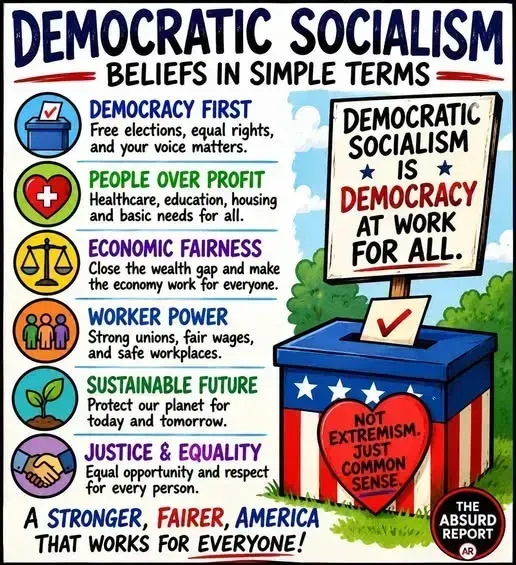
Democratic socialism highlights democratic governance, economic equality and social ownership or regulation of key industries, coexisting with private enterprise. Democratic socialism seeks a gradual transformation of the economy toward collective (group) ownership and workplace democracy. Countries and leaders applying these ideas focus on universal access to crucial services, income redistribution and worker participation in economic decision-making (unions).
Theodore Roosevelt (R), the 26th President of the United States, recognized the need to put safeguards in place for what he called the common good. “The welfare of each of us is dependent fundamentally upon the welfare of all of us.”
In 1905, he urged Congress to create the Forest Service in order to manage government-owned forest reserves. He used his presidential authority to set aside public lands as national forests making them off-limits to commercial exploitation of lumber, minerals and waterpower. The following year, Roosevelt pushed Congress to pass the Pure Food and Drug and Meat Inspection acts, creating agencies to ensure consumer protections. He got Congress to grant powers to the Interstate Commerce Commission to regulate interstate railroad rates. The Hepburn Act of 1906 conveyed those powers, creating the federal government’s first regulatory agency.
All acts of democratic socialism.
When his cousin Franklin D. Roosevelt (D) became president in 1933, he led America through two of the biggest crises of the 20th century: the Great Depression and World War II. In doing so, he significantly expanded the powers of the federal government through programs and reforms known as the New Deal.
America is steeped in democratic socialist policies. Everywhere you look, you'll discover socialist programs in all facets of American life. Social Security, Medicare, farm subsidies, public schools, minimum wage, the New Deal, the Federal Housing Administration and so much more have their roots in democratic socialist ideals.
Examples of democratic socialism that most people take for granted and don’t think about every day: Social Security, Medicare, Medicaid, public schools and colleges, libraries, our system of highways, national parks, unions, labor protections (think child labor laws), social welfare programs (like SNAP). Democratic socialism in America is not a single system, rather a set of policies and practices meant to reduce inequality, expand public services, and empower workers.
Democratic socialism is just what it sounds like – democracy at work for all! What a concept!
If you believe in economic equality, free and fair elections, equal rights for everyone, public education, affordable healthcare and housing as basic rights, livable wages, strong unions, safe workplaces, environmental protections, addressing climate issues for future generations and believe in equal opportunity for everyone, you might be a democratic socialist!
How does America compare to other countries? 15 Democratic Socialist Countries and Social Democracies | HowStuffWorks
"Call it democracy, or call it democratic socialism, but there must be a better distribution of wealth within this country for all God's children." ~ Martin Luther King, Jr.