
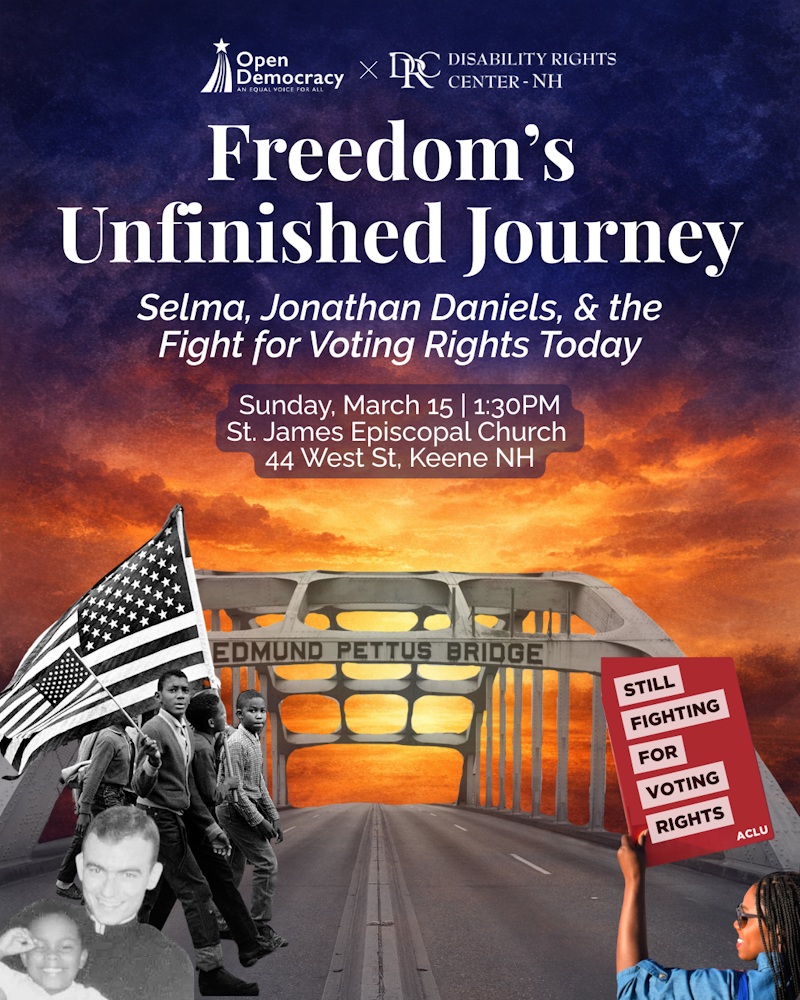
As part of a voting rights movement and despite ongoing segregationist repression, Martin Luther King Jr. and the Southern Leadership Christian Conference (SCLC) led protest marches to the Dallas County Courthouse during Jan. and Feb. 1965. On Feb. 18th, an Alabama state trooper shot protester Jimmy Lee Jackson, who died eight days later. In response, a protest march from Selma to the state’s capital in Montgomery was scheduled for March 7.
Along that 54 mile stretch of highway from Selma to Montgomery, three protest marches took place. These nonviolent marches were organized as a means of African-American citizens pushing for their constitutional right to vote. Six hundred people gathered in Selma on Sun., March 7, now forever known as "Bloody Sunday." The late Congressman John Lewis led them and other SCLC activists on this march. Before crossing the Edmund Pettus Bridge over the Alabama River to Montgomery, they were blocked by Alabama State Police and local police, ordering them to turn around. When the unarmed protesters refused, the police shot tear gas into the crowd, beating the nonviolent protesters with batons, resulting in over fifty people being hospitalized. Lewis himself suffered a fractured skull. Another march took place a couple days later, but because of the unrest didn’t amount to much.
On March 21, thousands of protesters marched along US Route 80, reaching Montgomery on the 24th. On March 25th, roughly 25,000 people held a demonstration on the steps of the State Capital. The resulting Voting Rights Act of 1965 was signed into law on Aug. 6, 1965 by President Lyndon Johnson.
The march route is memorialized and designated as the Selma to Montgomery National Historic Trail and is a reminder to all of us that nonviolent protests and perseverance can and do work!
Jonathan Myrick Daniels was born on March 20, 1939, in Keene and was an Episcopal seminarian and civil rights activist. In 1965, Daniels joined the civil rights movement in Selma, Alabama returning to the seminary in Massachusetts to take his exams. In July, he returned to Selma where he tutored children, assisted the poor in applying for aid and helped register new voters.
On Aug. 14, 1965, Daniels was one of 29 protesters who went to Fort Deposit, Alabama to picket whites-only stores. Subsequently, they were all arrested and taken in a garbage truck to a jail in the nearby town of Hayneville and were held for six days. On Aug. 20th, they were released, waiting near the courthouse jail as one of their members called for a ride back to Fort Deposit. Daniels and three others, a white Catholic priest and two black female activists, went to buy a cold soft drink at nearby Varner's Cash Store, one of a few places to serve non-whites. Standing in front of the store was Tom L. Coleman, an unpaid special deputy, holding a shotgun and had a holstered pistol. Coleman threatened the group, pointing his gun at seventeen-year-old Ruby Sales. Daniels pushed her down, catching the full blast of the shotgun and was killed instantly.
Hearing of Daniels' murder, Martin Luther King Jr. stated, "one of the most heroic Christian deeds of which I have heard in my entire ministry was performed by Jonathan Daniels." His death brought further support for the civil rights movement. In 1991, the Episcopal church designated Daniels a martyr and he is recognized annually in the Episcopal church.
Fifty years later, this country is still in a fight for voting rights. Here in New Hampshire we have seen one voter suppression bill after another get passed into law by Republican legislators who hold the majority and want to keep it that way by making it harder to vote. So, this is the perfect segue into an upcoming event being held to address that issue, still fighting for voting rights.
On Sun., March 15th at the St. James Episcopal Church in Keene there will be an event titled “Freedom’s Unfinished Journey.” The event runs from 1:30-3:30 and scheduled speakers are:
~Rev. Elsa Worth will give an introduction
~Olivia Zink from Open Democracy
~Deborah Opramolla, Following Jonathan Daniels Example Meet the Team here at Disability Rights Center NH
~Prof. Larry "Lawrence" Benaquist, made a documentary "Here am I, send me. The Journey of Jonathan Daniels."
I’m told there’s also food!
“If voting didn’t matter much, foreign governments wouldn’t try to influence it. And if voting didn’t matter much, we wouldn’t see efforts in America to make it harder for certain people to vote. Your vote does matter.”
― Kim Wehle, law professor, University of Baltimore School of Law